iNDiViDUALS
An interactive video installation built with Tevin Stuurland and AMFI students, letting visitors steer a sustainable-fashion narrative from a tablet linked by WebSocket to a large-scale projection.
Overview
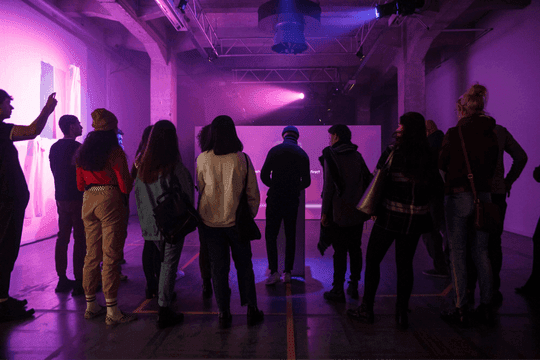
The Amsterdam Fashion Institute (AMFI) holds an annual exhibition for its student-run clothing lineiNDiViDUALS. In collaboration withTevin Stuurlandand the AMFI students, I built an interactive video installation for the December 2018 event: an experience explaining the line's sample-production process, reframed through the lens of sustainable fashion.
Concept
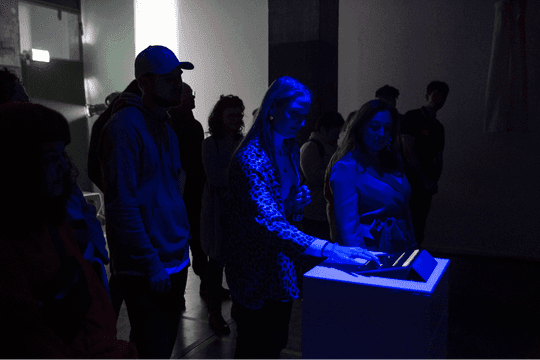
The installation occupied an industrial hall, placing visitors in front of a large projection. An interactive video played on screen and invited visitors to make decisions using a tablet positioned nearby.
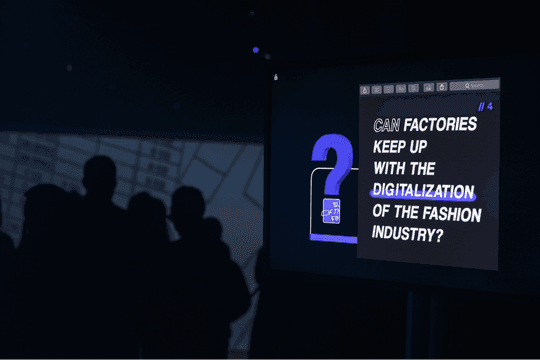
One of the narrative's framing questions, projected large:"Can factories keep up with the digitalization of the fashion industry?"
Narrative structure
The video isn't a single explainer; it's a branching decision tree, standing in for a factory account manager checking in with three named contacts, each representing a different production stage: Noah Shahzdah, Zack Lee, and Alex Pierce. Visitors first choose which e-mail to check, then follow that contact's branch to its own decision: Noah's factory has no questions, so the choice is simply to wait or call them directly; Zack's factory needs a spec sent over, by video or PDF; Alex's factory gets offered a 3D PDF or a video sent over WhatsApp. Every path ends the same way, a "Thanks for watching" screen, after playing that branch's own pre-recorded video clip — eleven clips in total across the three contacts, each shot specifically for its choice.
System architecture
I linked the two interfaces with a WebSocket connection (Socket.IO) between the tablet web application and the browser running the projection, letting visitor choices on the tablet drive the narrative on the projection in real time. The controller renders each step's question and choice buttons from a small state machine mirrored on both ends; the screen side plays the matching video clip for whichever branch was chosen, then advances to that branch's next question until a path resolves to its ending.
Reflection
The WebSocket link is a simple piece of plumbing, but it's what turned a linear explainer video into something visitors actually steered — the tablet's presence next to the projection, rather than in visitors' own hands, kept the interaction social and visible to the room rather than private. Building it as three genuinely different named contacts, rather than one branching abstract question, is what made the sustainable-fashion argument (do you wait, call, or ship another physical sample?) land as a concrete choice rather than a lecture.