IBM x GRAMMY Museum: Music Discovery Interface
A permanent interactive table at the GRAMMY Museum that replaced a recommender with an editorial system of five IBM watsonx agents authoring a music-history knowledge graph, built at FIELD.IO.
Overview
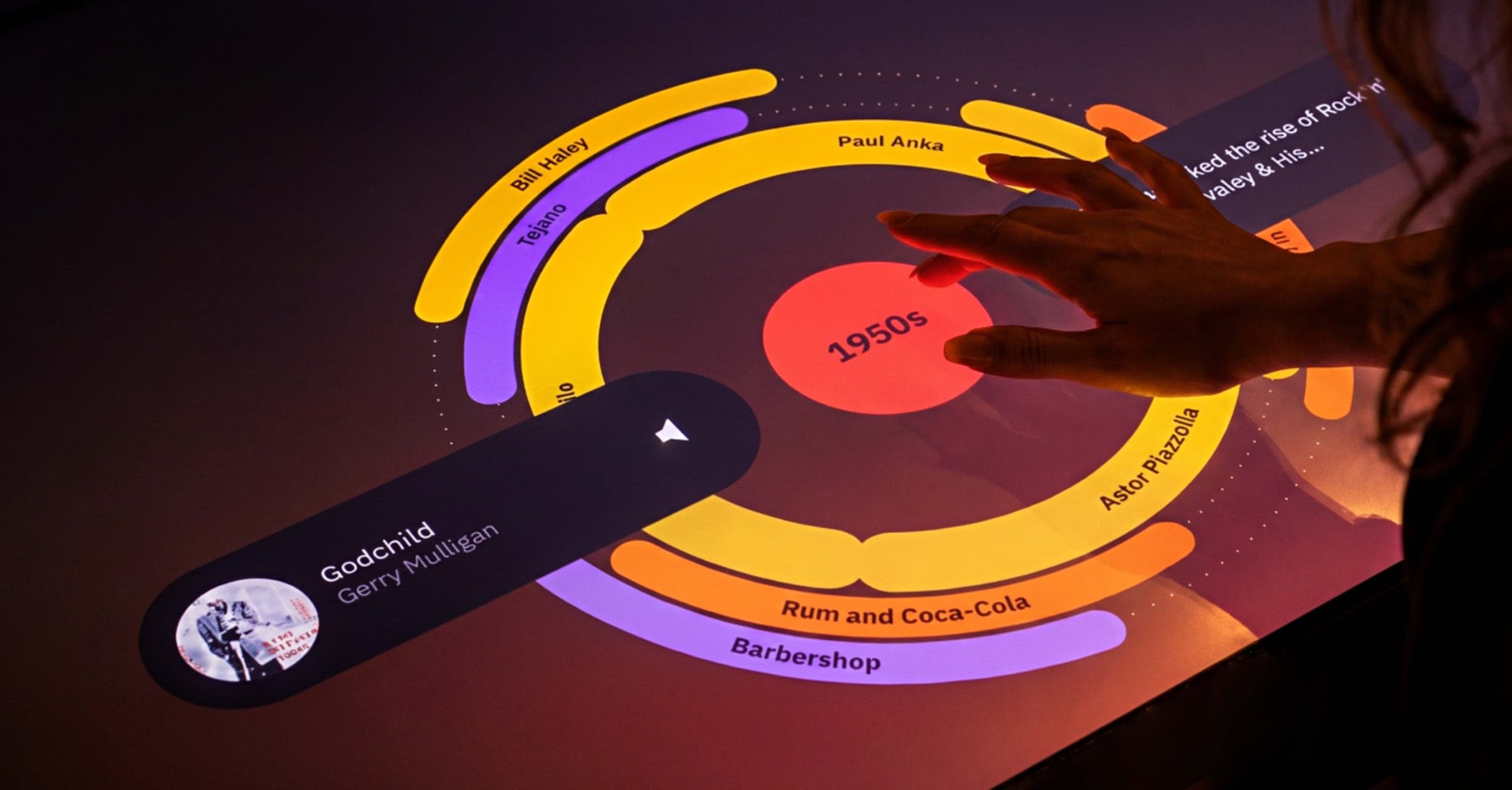
Music Discovery Interface is a commercial client project built atFIELD.IOforIBMand theGRAMMY Museum: a permanent interactive table letting visitors tap a track, artist or genre and traverse a graph of researched, written, and audited connections across recorded music history. Credited as Development:Bruno Imbrizi, Casper Wortmann, Daan Rongen, Guido Schmidt, Yi-Wen Lin. Daan also wrote up the project's technical approach in a public article,"Building Agentic Systems for Cultural Archives", which this note draws on directly.
From a recommender to an authored graph
The brief was simple to state: let a visitor pick a track, artist, or genre and find their way to related content. The first build answered it the obvious way, as a recommender. Ten-second audio chunks were embedded through bothCLAPandMERTfor timbral and emotional character; lyrics were transcribed withWhisperand re-embedded with a sentence transformer; artist biographies went through the same pipeline. A KNN pass across the resulting latent spaces built a similarity graph, projected down through UMAP/t-SNE for the table's constellation view.
That build exposed the difference between proximity and meaning. Spanish-language tracks clustered together because Whisper had transcribed them as Spanish, not because they were culturally related; instrumental tracks collapsed together because Whisper transcribed them via closed captioning. The team stopped asking the systemwhat is nearestand started askinghow are these related— a data-aggregation problem rather than a Cartesian one. The graph stopped being learned from embeddings and becameauthored: every edge carries a label, a direction, and a weight that can be interrogated.

A five-agent editorial pipeline, not a recommender
The system that replaced the recommender is shaped like an editorial department rather than a model: five isolated agents, each with its own context, tools, prompt and output schema, running onIBM watsonxagainst theGranite 4H Smallfamily, sitting atop aNeo4jgraph that is the archive itself. There is no orchestrator delegating to sub-agents — the orchestrationisthe pipeline, and the reasoning stays local to each role rather than being wired into a hierarchy. Working against a small, on-premise-friendly model rather than a frontier one was a real design constraint: it pushed every role toward small, isolated, testable functions with tight prompts and strict output schemas, since the authored graph had to carry much of the model's reasoning itself.
- Research — queries trusted music data sources by tool call, sanitises the responses, and returns atomic facts tagged by category (biography, history, style, influence, impact), extracting synthetic Place and Decade nodes along the way.
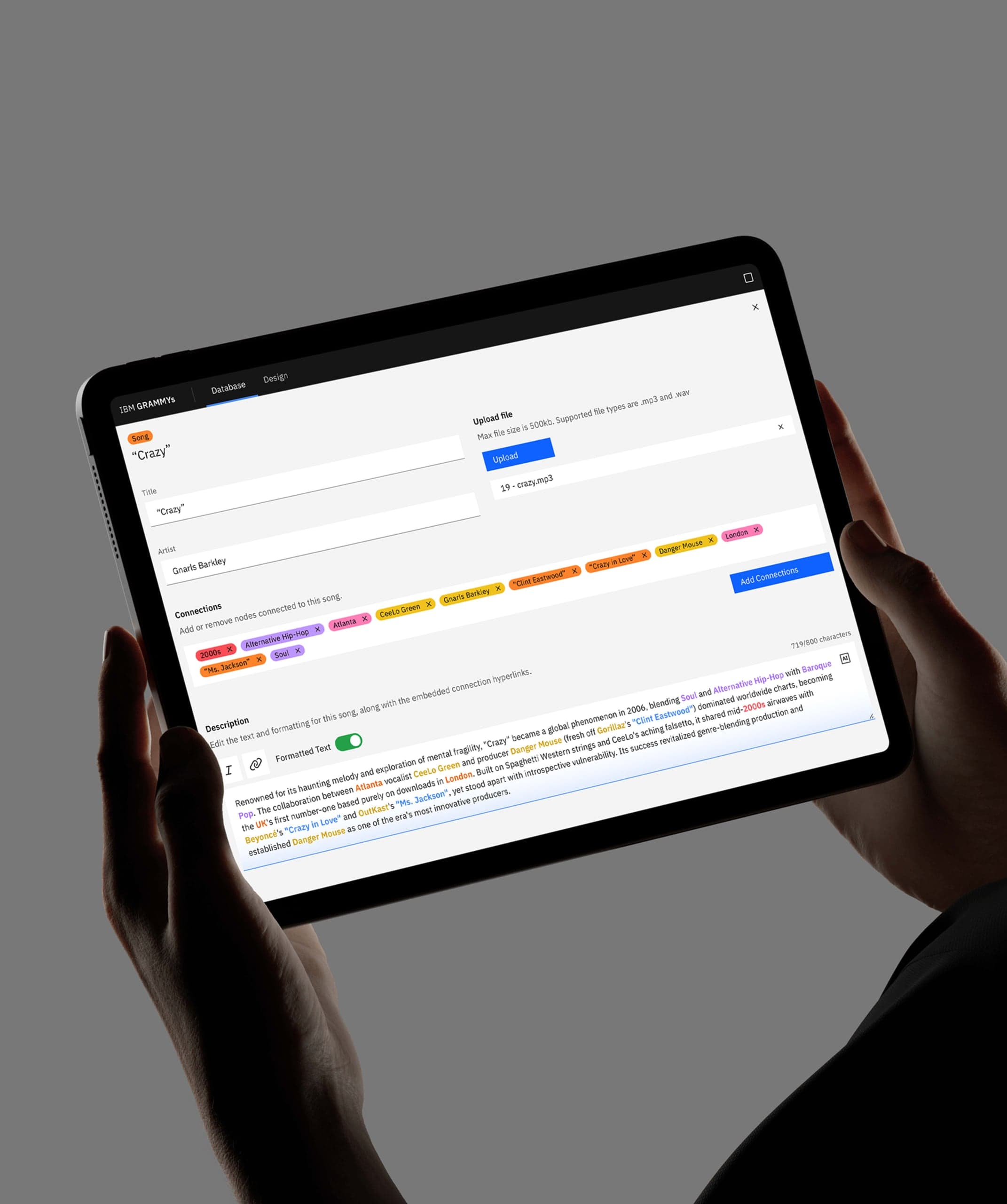
- Describe — reads those facts plus the node's weighted neighbours and writes the museum copy, referencing connected nodes by name; a tool wraps each reference in an anchor tag so the installation text becomes navigable, with higher-weight relationships anchoring earlier sentences.
- Evaluate — scores the description against the research log on five rubrics (factuality, style, specificity, context use, grounding), each on a 1-5 scale with recorded reasoning; it never rewrites, only flags what's wrong and why, calibrated against a golden-standard set of human-written samples.
- Refine — rewrites narrowly to correct what evaluate flagged and strip what exceeds the evidence, recording its own reasoning as a diff back to specific evaluation criteria.
- Report — the one agent that runs live, at the table, reading a visitor's traversal as a behavioural signature (nodes visited, order, dwell category, graph paths between interests) and returning a title, a short paragraph, and one onward recommendation, so a visitor leaves with an account of the path they made through the graph rather than a generic recommendation.

A curator-facing CMS sits on top of the same API, surfacing a node's weighted neighbours, its research log, the describe agent's draft, the evaluate agent's scores, and the refine agent's rewrite in one view — approval stays an editorial decision, the agents only prepare the material around it.
Presentation
The installation is a permanent, physical table at the GRAMMY Museum, giving visitors a shared, real-time way to gather around and traverse music-history connections together rather than individually on headphones.

Reflection
The team-shaped architecture (five isolated roles on a pipeline, not a single long prompt or an orchestrator/sub-agent hierarchy) is more expensive to build than one larger prompt, but the gain is legibility of failure: language models fail plausibly rather than loudly, and isolating roles shrinks the failure surface to one agent at a time, so a single failing role can be re-prompted without touching the others. The deliverable here is unusual in that sense: the client wasn't only buying an installation's output, but its ongoing behaviour — roles, prompts, schemas, review states and failure visibility are as much a part of the experience as the physical table.