Fractional Brownian Motion
A GLSL colour-blending study built on fractal noise, using Fractional Brownian Motion as a substrate for organic, layered colour fields instead of terrain.

Overview
After working throughThe Book of Shaders, I set out to experiment with Fractional Brownian Motion (FBM) in GLSL over a few days in April 2021. FBM stacks successive layers of noise at increasing frequencies and decreasing amplitudes, producing the organic, natural-looking surfaces typically used to procedurally generate terrain: mountains, valleys, cave systems.
Concept
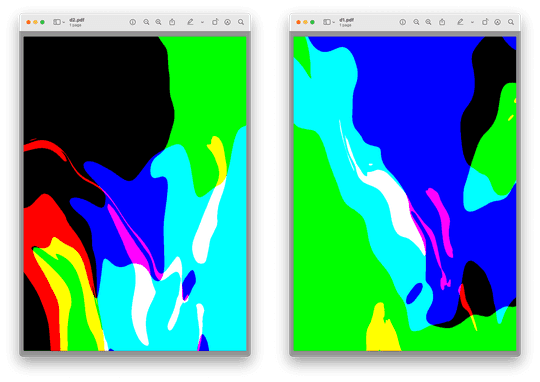
Rather than terrain, I used FBM as a substrate for colour experimentation. I implemented a set of blend modes where overlapping colour fields are interpolated through the fractal noise field, generating emergent hues at every intersection — a series of fluid, layered compositions that read as organic rather than computed.
Presentation
Five print-ready outputs survive from the project (A3.pdfplus two pairs of digital/large variants,d1/d2andl1/l2), alongside a screen recording of the live shader dated 11 May 2021 — evidence the piece was iterated on for at least a month past its initial April build, well past a single-session sketch.
Reflection
The interesting result wasn't the noise function itself, which is a standard technique, but treating it as a colour-mixing substrate rather than a height map — swapping the domain FBM is usually applied to is what produced compositions that don't look like terrain-generation output.